Why a flocking machine cannot simply be converted into an abrasive grain coating machine
In industrial manufacturing, electrostatics are used not only for dust removal and spray coating, but also for the controlled deposition and orientation of materials.
Electrostatic flocking and electrostatic abrasive coating are two representative applications of this principle.
Interestingly, the two processes share a common origin. In 1926, during sandpaper manufacturing trials, the U.S. company Behr-Manning sought to orient abrasive grains with their sharp points facing outward for better cutting performance. This work revealed the directional effect of electrostatic deposition—an effect that later evolved into modern electrostatic flocking technology. In that sense, the need to orient abrasive grains helped give rise to flocking technology, and the two processes have been closely related from the beginning.
At first glance, both processes use a high-voltage electrostatic field to move material onto an adhesive-coated substrate. This often leads to a seemingly reasonable question:
Is electrostatic abrasive coating simply a matter of replacing the flock fibers in a flocking machine with abrasive grains?
The answer is no.
Although the two processes share a similar physical foundation, fibers and abrasive grains differ greatly in mass, shape, density and end-use function. These differences create fundamentally different requirements for machine design and process control.
Electrostatic flocking is primarily used to deposit short fibers—such as nylon, rayon or polyester—onto a substrate that has already been coated with adhesive.
Under a high-voltage electrostatic field, the fibers experience an electrostatic force, align with the field and become embedded in the adhesive layer.
Unlike abrasive grains, which rely mainly on dielectric polarization, flock fibers are charged through a combination of contact charging and polarization. The fibers acquire a net charge by contacting an electrode, while also becoming polarized as dipoles. They rotate until they align with the electric field. This is why the fibers stand upright instead of lying flat. To achieve uniform charging, synthetic flock must also receive a conductive pretreatment that controls its surface conductivity and improves fiber straightness and flight behavior.
One of the primary objectives is to:
Arrange large numbers of short fibers as uniformly and vertically as possible across the substrate.
Typical flock ranges from 0.8 to 80 denier and is generally 0.3 to 1.0 mm long. Premium flocked fabrics may contain 2,000 to 2,800 fibers per square millimeter and withstand thousands of abrasion cycles.
Electrostatic flocking is therefore widely used in:
Automotive interiors
Textiles and decorative materials
Packaging materials
Sealing components
Industrial surface treatment
Medical and hygiene products, such as sampling swabs
For flocking applications, fiber density, vertical alignment, uniformity and adhesion strength are all key performance indicators.
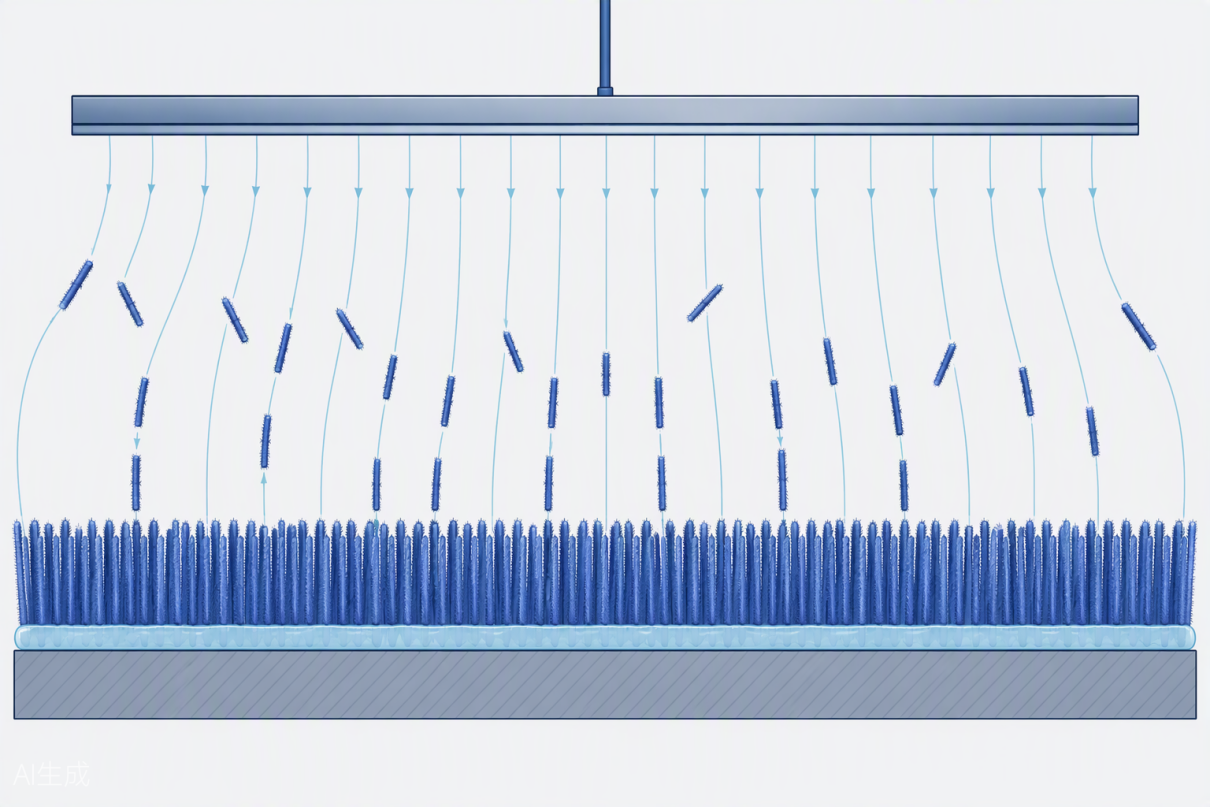
Figure 1 | Principle of electrostatic flocking: fibers travel along the electric field and embed vertically in the adhesive layer
Electrostatic abrasive coating is one of the core processes used to manufacture coated abrasives.
Unlike fibers, abrasive grains are typical dielectric materials and become responsive to the field through dielectric polarization. An external electric field shifts the centers of bound charges within each grain, creating a dipole that moves and aligns under electrostatic force. The dielectric constant of each abrasive therefore directly affects its coatability. Silicon carbide can be coated at relatively low voltage, while aluminum oxide requires a higher voltage. Diamond has traditionally been difficult to coat directly because its crystal structure does not readily form a dipole, so surface modification is generally required.
A typical sandpaper or abrasive cloth production process includes:
Unwinding → Make coat application → Electrostatic grain coating → First curing stage → Size coat application → Second curing stage → Finishing
In industrial systems, electrostatic abrasive coating commonly uses low-frequency AC high voltage from 0 to 60 kV; DC designs may reach peak voltages of 140 kV. Electrode spacing is typically about 50 mm. A representative production line may control abrasive conveying speed at 8–10 m/min and grain feed at 100–150 g/m², while supporting a broad coating-weight range of 1–300 g/m². Based on grain coverage, coated abrasives are commonly classified as closed coat (approximately 80%–100%, for heavy-duty metal grinding), open coat (approximately 50%–80%, for woodworking) and very open coat (approximately 20%–50%, for clog-resistant applications such as paint sanding).
Unlike flocking, electrostatic abrasive coating handles relatively heavy particles with irregular geometries rather than lightweight fibers. Common abrasive materials include:
Aluminum oxide
Silicon carbide
Zirconia alumina
Ceramic abrasive grain
The purpose of electrostatic abrasive coating is not simply to:
“Stick abrasive grains onto sandpaper.”
More importantly, a properly designed electrostatic field gives the grains favorable motion and orientation, improving their arrangement and distribution within the adhesive layer.
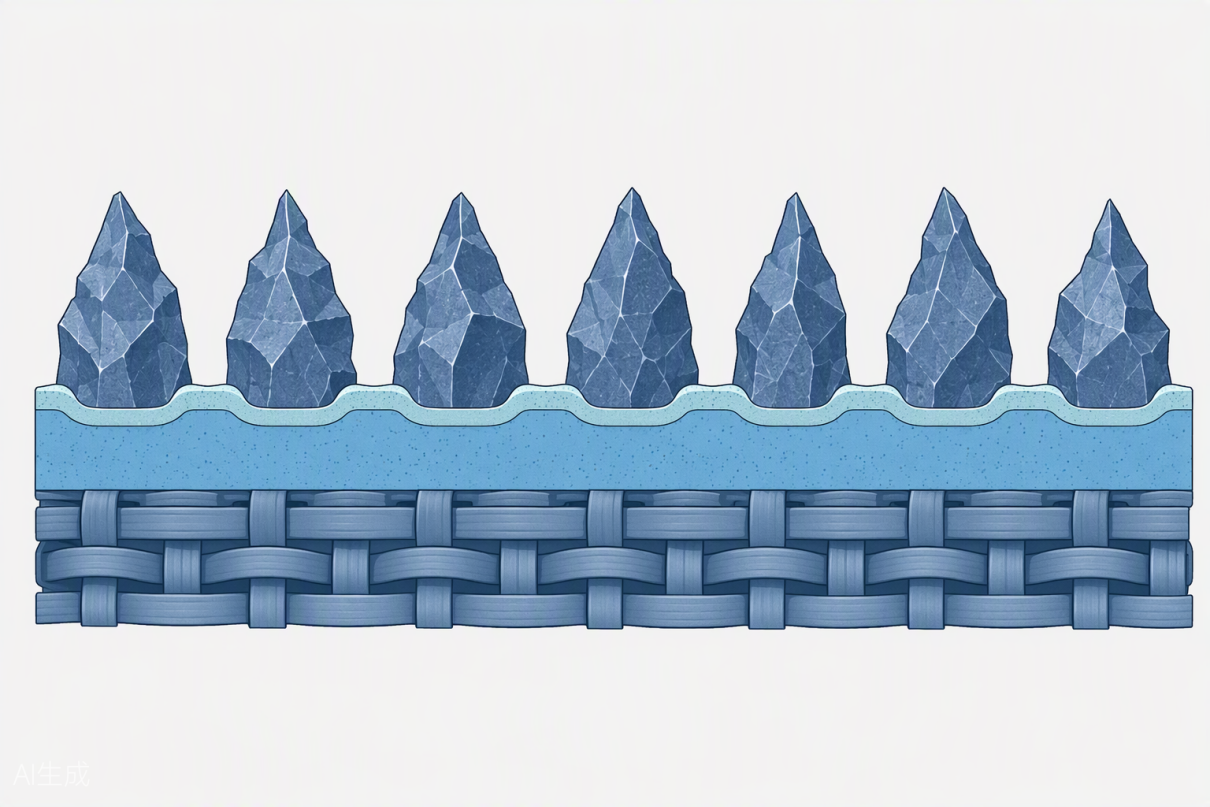
Figure 2 | Cross-section of a coated abrasive: backing, make coat, oriented abrasive grains and size coat
This is one of the key differences between electrostatic abrasive coating and conventional gravity coating.
When abrasive grains fall onto an adhesive layer under gravity alone, their orientation is largely random.
Some grains lie flat, some land at an angle, and only some expose a sharp cutting edge.
Electrostatic force acts broadly through the grain’s center of mass. As a result, the larger end tends to embed in the adhesive while the sharper end points outward toward the grinding surface. This orientation naturally supports the main performance requirements of coated abrasives: sharp cutting action and a more consistent grain height.
In coated abrasives, the grains ultimately perform the cutting action.
Under otherwise identical conditions, the position of each grain in the adhesive layer and the exposure of its effective cutting edges influence the final grinding performance.
One of the main benefits of electrostatic coating is its ability to improve grain orientation and arrangement, allowing more effective cutting edges to participate in grinding.
Available data also support this advantage: electrostatically coated abrasive belts can achieve grinding efficiency more than 25% higher than belts produced by conventional gravity coating, while delivering more consistent surface roughness and reducing loading on the abrasive surface.
Therefore, evaluating an electrostatic abrasive coating machine requires more than asking:
“What is the voltage?”
The more important question is:
How are the abrasive grains actually deposited onto the backing?

Figure 3 | Grain orientation comparison: gravity coating (left, random and flat-lying grains) versus electrostatic coating (right, sharp points facing outward)
| Comparisom | Electrostatic Flocking | Electrostatic Abrasive Coating |
| Deposited material | Short fibers | Abrasive grains |
| Typical materials | Nylon/Rayon/Polyester | Aluminum oxide / Silicon carbide / Zirconia alumina / Ceramic grain |
| Changing mechanism | Contact charging plus polarization:flock requires conductive pretreatment | Dielectric polarization; dielectric constant affects coatability |
| Typical electric field | DC40-100kV | Low-frequency AC 0–60 kV; DC designs may peak at 140 kV |
| Quality indicators | Density,vertical,alignment and adhesion | Coating weight and coverage: closed, open or very open coat |
| Material characteristics | Lightweight and elongated | Heavier and irregularly shaped |
| Primary objectives | Uniform,upright fibers | Grain orientation, distribution and coating weight |
| Substrates | Textiles,plastics,automotive interiors and others | Paper, cloth, film and other coated-abrasive backings |
| End products | Flocked materials | Sandpaper, abrasive cloth, abrasive belts and related products |
| Key machine controls | Fiber density and vertical alignment | Electric field, grain feed, coating weight, uniformity and grit adaptability |
| Downstream process | Curing and cleaning | Make coat, size coat and multi-stage curing |
In summary:
The electrostatic principle may be similar, but the material properties, process objectives and complete engineering design of the equipment are very different.
This is a common misconception during equipment selection.
Because flocking equipment may also use high-voltage systems operating at tens or even hundreds of kilovolts, some people assume that sufficiently high voltage is all that is required for electrostatic abrasive coating.
In reality:
High Voltage ≠ Good Abrasive Coating
High voltage alone does not guarantee good abrasive coating results.
Abrasive grains and flock fibers differ substantially in mass, density, particle size, shape and electrical properties.
The electrical differences are particularly important. The dielectric constant of the abrasive and the surface resistivity of the fiber require completely different field configurations and voltage windows. An abrasive coating machine must also accommodate a wide grit range from P40 to P2000 while maintaining the production environment at 25°C ±2°C and 50% ±5% relative humidity. This involves far more than replacing the high-voltage power supply.
Especially when continuously producing with different grit sizes, the equipment must account for the combined effects of:
High-voltage field design, electrode structure, electrode spacing, abrasive feeding, grain-bed condition, conveying speed, abrasive recovery and recirculation, insulation design, safety protection and the production environment.
These parameters interact with one another and collectively determine coating performance.
A genuine electrostatic abrasive coating machine for coated-abrasive production is therefore a complete process system engineered around the controlled orientation and deposition of abrasive grains.
At WINSING Intelligent Manufacturing, we focus not on a single high-voltage rating, but on the complete process:
Creating a rational and stable electrostatic field for the specific product, abrasive material and manufacturing process.
Improving the movement and alignment of abrasive grains within the electric field.
Maintaining consistent abrasive distribution across both the width and the length of the web.
Matching the process to different abrasive materials and grit-size ranges.
Good results during a short trial are not enough. The equipment must remain stable throughout continuous industrial production
As the coated-abrasives industry moves toward higher efficiency, greater consistency and more precise manufacturing, the value of production equipment is also changing.
Electrostatic abrasive coating should not merely answer:
Can we apply the abrasive grains?
It should answer a more important question:
How can we control the way abrasive grains are applied?
In other words, the industry is moving from:
“Can the grains be coated?”
to:
“How can the grains be deposited more uniformly, more consistently and in a more effective orientation within the adhesive layer?”
This is the direction WINSING continues to research and develop in the field of coated-abrasive manufacturing equipment.
More uniform abrasive distribution. More stable production.
WINSING specializes in coated-abrasive production equipment and related intelligent machinery, providing integrated solutions ranging from individual machines to smart factories for coated-abrasive manufacturing.
WINSING Abrasive Machinery Division
Coated Abrasives Manufacturing Equipment
Electrostatic Abrasive Coating Technology
Abrasive Converting and Automation Solutions
WINSING Intelligent Manufacturing · Serving Global Industry
.
Contact: Frank
Phone: +86 15895185181
Tel:
Email: info@winsing-machinery.com
Add: 282-A Long Yuanhao, Xuanjia Village, Economic Development Zone, Changzhou City, Jiangsu Province Office Address: No. 2258, Huhang Rd, Fengxian District, Shanghai.
We chat